Showing posts with label Christianity. Show all posts
Tuesday, May 14, 2013
Desire
If you desire popularity, know that there will always be people way more sought after than you.
If you desire praise, know that there will always be people much more deserving of it.
If you desire to be beautiful, know that there will always be people who appear much more beautiful than you.
If you desire beauty, know that there will always places and objects more majestic, elegant, and sublime.
If you desire to be trendy, know that that there will always be people more au courant.
If you desire knowledge, know that for every subject and speciality you learn about, there will always be people who knows a heckofalot more than you.
If you desire wisdom, know that there will always be people who can come up with better solutions in less time.
If you desire to be religious, know that you will always find people who make you look like a miscreant.
If you desire sexual fulfilment, know that the term is an oxymoron outside of marriage.
If you desire money, know that there will always be people with 100 times more money than you.
If you desire God, know that He is not far from any one of us.
If you desire love, seek God.
If you desire joy, seek God.
If you desire peace, seek God.
Tuesday, April 9, 2013
Christian Music 101
What is Christian music?
Christian music is not a genre; rather, it is a very broad category of music made by followers of Christ who want to glorify God in some way with their art. "Christian music" is much like the extensive term "Canadian music" – rather than being restricted to one specific form, it is a quite general term that can be applied to music in virtually every genre. There are two basic types of Christian music:
Worship music is the kind of music that is suitable for singing in church services. These songs usually have "vertical lyrics," meaning that the lyrics of the song are addressed specifically to God, so the people worshiping feel like they are singing to God directly. This includes hymns, gospel music, and contemporary worship. Even within worship music there is a wide range of musical styles, from solemn, traditional renderings of 18th century hymns to the upbeat experimental post-rock songs of Gungor and Bellarive.
Nonworship music is music written by Christians to glorify God, but meant for general listening rather than being played in a church service for worship. Although there are so-called "Christian record labels," there are also many Christians who publish music with secular, mainstream record labels. The Christian rock scene is vibrant, including the symphonic metal band Skillet, the alternative surf rock band Switchfoot, and the Canadian metal band Thousand Foot Krutch. The Christian rap/hip hop scene is also thriving, led by rappers such as TobyMac and Lecrae.
Classical music owes a great deal of its success to Christian composers and patrons. Johann Sebastian Bach, one of the greatest composers of all time, was a devout Lutheran and devoted every one of his works "to the glory of God." Christians have also played a large part in the history of country music; Johnny Cash himself was unashamed to say he was a Christian, and sang a number of gospel songs. I've also listened to Christian artists from the genres of synth-pop (Owl City), electronic dance music (GodsDJs.com), jazz (Christian Jazz Artists Network), reggae (Papa San), acoustic rock (Mat Kearney), and even beatboxing (Peterpot).
How much does a band need to sing about God to be a "Christian band"?
I don't think that a "Christian band" necessarily even needs to mention God in any of their songs. If the band members are true followers of Christ, then their beliefs should be evident in their music. However, explicit references to God or religion are not necessary.
For example, Adam Young (the genius behind Owl City) rarely mentions God in his music, but keeps his songs clean and positive and isn't afraid to identify as a Christian. In 2011 he told the Christian Post in an interview, "My prayer is that the music of Owl City serves as a bright light in a very dark place, a ray of hope in this haunted house of a world. I want the Lord Jesus to use my music to do WHATEVER it is He wills."
Is it wrong to listen to nonChristian music?
I think it all depends on whether or not the music you're listening to is going to affect your thoughts and behaviour, tempting you to sin. I listen to lots of music written by nonChristians, but I'm careful to remember that what I listen to can influence me profoundly.
Lots of modern music has references to using illegal drugs, abusing alcohol, violence, lust and sexual immorality, pride, greed, hate, disregarding the consequences of your actions, and excessive concern with outward appearances and popularity. However, music affects each of us differently.
If you can listen to Pumped Up Kicks without having the song change your views on violence, then I'd say it's okay to listen to. If you can listen to Thrift Shop without becoming excessively vulgar, materialistic, and prideful, then I'd say it's okay to listen to it. If you can listen to We Are Never Ever Getting Back Together (one of my favourite Taylor Swift songs) without getting overly bitter about a breakup you've experienced, then I'd say it's okay to listen to it. But as soon as a song starts inciting you to sin, I would recommend to back away and stop listening. That goes for any song, regardless of the religious beliefs of the person who wrote it.
Saturday, February 23, 2013
Homosexuality and the Christian Community
![]() |
There is a significant and divisive debate in the Christian community over whether or not homosexuality is sinful. Many people believe that all Christians are "anti-gay," but there is really no consensus on homosexuality among Christians. Some conservative Christians are vehemently opposed to homosexuality and gay rights, believing that homosexuals should "become straight." However, some liberal Christians fully support homosexuality and gay rights, emphasizing God's love and forgiveness. Many Christians find a middle ground, believing that being attracted to the same sex is okay, but that the Bible prohibits sexual behaviour between people of the same gender. This wide range of beliefs is reflected in the differing positions of Christian churches and organizations. The United Church of Canada welcomes homosexuals into its congregations and allows its clergy to perform same-sex marriages. The official catechism of the Roman Catholic church states that homosexuals can be Catholics, but that they are called to chastity. The New York Times reported about a conservative evangelical Baptist church in Ausbury Park, New Jersey that attended the city's annual gay pride celebration, giving out water bottles. The church believes that homosexuality is a sin, but went "to show God's love" to the people there.
The debate over homosexuality in the Christian community largely centers around particular Bible verses relevant to the issue (e.g. Leviticus 18:22 and 1 Corinthians 6:9). Scholarly, contemporary translations of the Bible (such as the New International Version) support the view that homosexual behaviour is sinful, though not necessarly same-sex attraction (an important distinction). However, some Christians believe that the Bible has been misunderstood and mistranslated, arguing that the Bible means to condemn other practices such as child abuse and rape instead. This is likely a debate that will divide Christians for many years to come, with implications for the relationship between the Christian and LGBT communities. However, Christians from every standpoint should be able to agree on the importance of treating homosexuals with love and respect, as the Bible commands (Mark 12:31 and Proverbs 10:12). It is also helpful to consider that too much of an emphasis on sexuality can detract from the Bible's main message, that of the forgiveness found in Jesus Christ.
In writing this post, I have done my best to put aside my own beliefs on the subect and remain unbiased, in order to present an impartial summary of the differing standpoints Christians have on homosexuality. You can read my personal standpoint here.
Sunday, January 6, 2013
Hiding the Supernatural: The origin of matter
The first law of thermodynamics states that energy and matter cannot be created or destroyed, it can only change its form. This physical law is one of the foundations of natural science. When there is a undisputed, universal physical law stating that matter cannot be created, how is it possible to explain that matter exists? There are two possibilities – either matter has always been (it is eternal), or at one time matter did not exist and then began to exist.
There are many theories for how our universe (matter) came to be. Most people in the world believe that the universe was created by a supernatural being (creationism). Some believe that the universe has always existed. Others believe that the universe began billions of years ago, completely apart from any supernatural intervention.
The idea that the universe began completely apart from supernatural intervention is not consistent with the first law of thermodynamics. Anything that is of the physical world is subject to the physical laws of the world, and thus subject to the first law of thermodynamics. This law states that matter cannot be created or destroyed. Thus, in order for matter to be created, it must be created by something that is outside of physical laws and outside of the natural world (supernatural).
The idea that the universe has always existed is actually consistent with the first law of thermodynamics. If matter is eternal, then it never was created. It always was.
However, this theory does not sufficiently take into account the fact that for everthing that happens in the natural universe, there is a cause. In order for anything with mass to move, it must be moved by something other than itself. Because it is quite evident that there is motion in the natural world, there must have been something that moved first, enabling (e.g. causing) all other motion in the natural world. If there was not a "first mover," then this natural world could not be in motion, because everything natural that is moving is caused to be in motion by something else. This first mover must be outside of the laws of nature, because it has no natural cause for moving. In other words, this first mover must be supernatural.
The idea that the universe was created by something supernatural is consistent with the first law of thermodynamics, because physical laws only apply to the natural world. If a being is spiritual and supernatural, then it does not belong to the natural world, and it is not restricted by physical laws. The first law of thermodynamics is strong evidence for the theory that the natural universe began from something supernatural (in other words, that the universe was created). I dare say that the first law of thermodynamics effectively proves creationism.
All naturalistic, materialistic explanations of the origin of the universe merely hide the necessity of a supernatural creator, pretending to offer feasible alternatives to the logical, intuitive idea that the universe was created by a supernatural being. However, upon close analysis, there is no escaping from the truth that there is a creator who does not belong to this universe and is not bound by our physical laws.
***
This post was heavily influenced by Thomas Aquinas's proof for the existence of God in his famous book, the Summa Theologica. You can read the book online by following this link. Once you've realized that the book is way to long to read in its entirety, you can read his relatively short proof for the existence of God by following this link.
***
The fool says in his heart, “There is no God.” – Psalm 14:1
Wednesday, October 24, 2012
The Place of Religion in Government
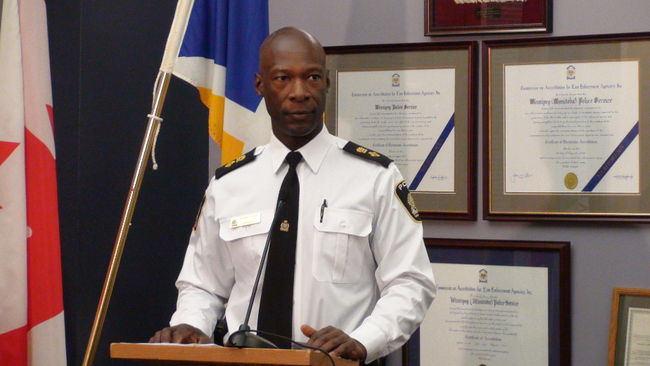
"This is about the health and the welfare, the well-being of our community. I'm not trying to create converts into any particular faith or religious belief system – that's not what this is about. But because I know this [faith] is such an integral part of so many individuals, why would we not engage that in terms of fighting crime and creating a better city for all our citizens?"
You can watch the interview by clicking here (it is about 15 minutes long).
As is to be expected in today's society, many strict secularists have called Mr. Clunis's comments inappropriate, postulating that religion is a private matter with no relevance in public settings and something that should definitely not be mentioned by any prominent government official. Unfortunately, some have even reached the conclusion that Mr. Clunis is unfit to be Winnipeg's police chief, merely because he talked about his personal faith and suggested that prayer is beneficial to society.
Here is what I think. Canada should have a full separation of religion and state, for three main reasons. Firstly, because religious institutions should not be able to dictate government decisions. Secondly, because the government should not be able to dictate the decisions of religious institutions, nor the spiritual decisions of individuals. Thirdly, because every citizen should be able to contribute to society and a person's religious faith should not determine whether or not he or she can hold a position in government.
That being said, Canada's constitution also guarantees religious freedom and freedom of speech, two basic human rights that are necessary for a country to be free and democratic. Without the freedom to make spiritual decisions for yourself and develop an individual worldview apart from government interference, and without the freedom to express those spiritual beliefs and act according to your own worldview, a nation cannot be a free and democratic country. Because these freedoms are so vital to Canadian society, our government should not proscribe or even discourage its citizens from expressing their religious beliefs (with the exception of hate speech that directly encourages the use of violence against any group or individual, which is incontrovertibly wrong and detrimental to society). Without this freedom to express spiritual beliefs and act upon them, freedom of religion is paralyzed and useless. Even the citizens of the dystopia depicted in George Orwell's novel 1984 could think as they wished. However, Big Brother forbid his citizens to act out on their beliefs or express them openly, killing the usefulness of their free will.
I believe wholeheartedly that these freedoms must correlate directly into government as well. Civil servants of all shapes and sizes must be able to determine their own beliefs, act upon those beliefs, and express those beliefs openly, even while on the job. The principle that government officials must "leave their religion at the door" as they begin their job and refuse to discuss matters pertaining to their core beliefs is not only anti-democratic, dangerous, and in violation of human rights, but also next to impossible. You cannot cut a person's mind in half to completely separate their beliefs pertaining to God and their other beliefs (such as those pertaining to politics, government, other people, and their job). A person's core beliefs will influence their job, whether they believe in Christianity, Islam, atheism, agnosticism, or any other worldview. This is especially evident with Mr. Clunis, who says that his Christian faith is foundational to everything he does.
Furthermore, a democratic government is supposed to represent all of its citizens. For that reason, government departments in Canada try to be racially diverse and include minorities. I see the inclusion of religion as a mere extension of that diversity. Government will never be able to get rid of religion. Our governments should instead embrace religion, realizing that allowing government officials to be religious while on the job is another way of representing their citizens more fully and enabling their officials to serve the public better.
In conclusion, I think government should be religion-inclusive, not religion-free. Devon Clunis's comments were certainly appropriate, and I will be praying with him for the people of Winnipeg.
Monday, October 8, 2012
Magnificent Orthodoxy
G.K. Chesterton (1874-1936) is one of Christianity's finest writers, and I would venture to say that he is among the English language's finest writers as well. While I'm at it, I might as well state also that his book Orthodoxy is one of Christianity's finest books, although at this point I should offer my sincere apologies for being so repetitive. Chesterton thought quite outside the box, drawing unexpected connections between things and using delightful metaphors. He was quite adept at finding mots justes, as well as "phrases justes" and "paragraphe justes." His writing always seems to have an undercurrent of irony and subtle humour, which becomes clear and obvious in the occasional sentence, and makes his works even more enjoyable.
I highly recommend this book to lovers of literature – bookworms, wordsmiths, and wannabe writers alike – as well as to those interested in religion, philosophy, Christianity, and Christian apologetics. Some parts can be difficult to understand, but if you can decipher my incoherent ramblings (and more importantly, appreciate my self-deprecating humour), I trust you have the intelligence to comprehend Chesterton's literary masterpiece.
Here are some of my favourite quotes from Orthodoxy:
Chapter 1:
I know nothing so contemptible as a mere paradox; a mere ingenious defence of the indefensible.
Chapter 2:
Thoroughly worldly people never understand even the world; they rely altogether on a few cynical maxims which are not true.
Poetry is sane because it floats easily in an infinite sea; reason seeks to cross the infinite sea, and so make it finite. The result is mental exhaustion, like the physical exhaustion of Mr. Holbein. To except everything is an exercise, to understand everything a strain. The poet only desires exaltation and expansion, a world to stretch himself in. The poet only asks to get his head into the heavens. It is the logician who seeks to get the heavens into his head. And it is his head that splits.
Mysticism keeps men sane.
Chapter 3:
The phrases of the street are not only forcible but subtle: for a figure of speech can often get into a crack too small for a definition.
Humility was largely meant as a restraint upon the arrogance and infinity of the appetite of man. He was always outstripping his mercies with his own newly invented needs... But what we suffer from today is humility in the wrong place. Modesty has moved from the organ of ambition. Modesty has settled upon the organ of conviction; where it was never meant to be. A man was meant to be doubtful about himself, but undoubting about the truth; this has been exactly reversed.
That peril is that the human intellect is free to destroy itself. Just as one generation could prevent the very existence of the next generation, by all entering a monastery or jumping into the sea, so one set of thinkers can in some degree prevent further thinking by teaching the next generation that there is no validity in any human thought. It is idle to talk always of the alternative of reason and faith. Reason is itself a matter of faith. It is an act of faith to assert that our thoughts have any relation to reality at all. If you are merely a skeptic, you must sooner or later ask yourself the question, "Why should anything go right; even observation and deduction? Why should not good logic be as misleading as bad logic? They are both movements in the brain of a bewildered ape." The young sceptic says, "I have a right to think for myself." But the old sceptic, the complete sceptic, says, "I have no right to think for myself. I have no right to think at all."
For we can hear skepticism crashing through the old ring of authorities, and at the same moment we can see reason swaying upon her throne. In so far as religion is gone, reason is going. For they are both of the same primary and authoritative kind. They are both methods of proof which cannot themselves be proved. And in the act of destroying the idea of Divine authority we have largely destroyed the idea of that human authority by which we do a long-division sum. With a long and sustained tug we have attempted to pull the mitre off pontifical man; and his head has come off with it.
We have no more questions to ask. We have looked for questions in the darkest corners and on the wildest peaks. We have found all the questions that can be found. It is time we gave up looking for questions and began looking for answers.
Thinking in isolation and with pride ends in being an idiot. Every man who will not have the softening of the heart must at last have the softening of the brain.
Madness may be defined as using mental activity so as to reach mental helplessness.
Chapter 4:
There is the great lesson of "Beauty and the Beast"; that a thing must be loved before it is loveable.
Children are grateful when Santa Claus puts in their stockings gifts of toys or sweets. Could I not be grateful to Santa Claus when he put in my stockings the gift of two miraculous legs? We thank people for birthday presents of cigars and slippers. Can I thank no one for the birthday present of birth?
Strike a glass, and it will not endure an instant; simply do not strike it, and it will endure a thousand years. Such, it seemed, was the joy of man, either in elfland or on earth; the happiness depended on not doing something which you could at any moment do, and which, very often, it was not obvious why you should not do.
Chapter 5:
For decoration is not given to hide horrible things: but the decorate things already adorable… Men did not love Rome because she was great. She was great because they had loved her.
Love is not blind; that is the last thing that it is. Love is bound; and the more it is bound, the less it is blind.
An imbecile habit has arisen in modern controversy of saying that such and such a creed can be held in one age but cannot be held in another. Some dogma, we are told, was credible in the twelfth century, but is not credible in the twentieth. You might as well say that a certain philosophy can be believed on Mondays, but cannot be believed on Tuesdays.
Chapter 7:
A strict rule is not only necessary for ruling; it is also necessary for rebelling. This fixed and familiar ideal is necessary to any sort of revolution.
As long as the vision of Heaven is always changing, the vision of earth will be exactly the same. No ideal will remain long enough to be realized, or even partly realized. The modern young man will never change his environment; for he will always change his mind.
What on earth is the current morality, except in its literal sense – the morality that is always running away?
The main point of Christianity was this: that Nature is not our mother: Nature is our sister. We can be proud of her beauty, since we have the same father; but she has no authority over us; we have to admire, but not to imitate.
Man must have just enough faith in himself to have adventures, and just enough doubt of himself to enjoy them.
I know that the most modern manufacture has been really occupied in trying to produce an abnormally large needle. I know that the most recent biologists have been chiefly anxious to discover a very small camel.
(A reference to Matthew 19:16-26)
Chapter 8:
Insisting that God is inside man, man is always inside himself. By insisting that God transcends man, man has transcended himself.
Men who begin to fight the Church for the sake of freedom and humanity end by flinging away freedom and humanity if only they may fight the Church.
Chapter 9:
Christianity is the only frame which has preserved the pleasure of Paganism. We might fancy some children playing on the flat grassy top of some tall island in the sea. So long as there was a wall round the cliff's edge they could fling themselves into every frantic game and make the place the noisiest of nurseries. But the walls were knocked down, leaving the naked peril of the precipice. They did not fall over; but when their friends returned to them they were all huddled in terror in the centre of the island; and their song had ceased.
Christianity is a super-human paradox whereby two opposite passions may blaze beside each other.
If anyone says that faith arose in ignorance and savagery, the answer is simple: it didn't. It arose in the Mediterranean civilization in the full summer of the Roman Empire.
How can we say that the Church wishes to bring us back into the Dark Ages? The Church was the only thing that ever brought us out of them.
A false ghost disproves the reality of ghosts exactly as much as a forged banknote disproves the existence of the Bank of England – if anything, it proves its existence.
This or that rite or doctrine may look as ugly and extraordinary as a rake; but I have found by experience that such things end somehow in grass and flowers. A clergyman may be apparently as useless as a cat, but he is also as fascinating, for there must be some strange reason for his existence.
This, therefore, is, in conclusion, my reason for accepting the religion, and not merely the scattered and secular truths out of the religion. I do it because the thing has not merely told this truth or that truth, but has revealed itself as a truth-telling thing. All other philosophies say the things that plainly seem to be true: only this philosophy has again and again said the thing that does not seem to be true, but is true.
The outer ring of Christianity is a rigid guard of ethical abnegations and professional priests; but inside that inhuman guard you will find the old human life dancing like children, and drinking wine like men; for Christianity is the only frame for pagan freedom. But in the modern philosophy the case is opposite; it is its outer ring that is obviously artistic and emancipated; its despair is within. And its despair is this, that is does not really believe that there is any meaning in the universe; therefore it cannot hope to find any romance; its romances will have no plots.
Melancholy should be an innocent interlude, a tender and fugitive frame of mind; praise should be the permanent pulsation of the soul.
Joy, which was the small publicity of the pagan, is the gigantic secret of the Christian.
There was some one thing that was too great for God to show us when he walked upon our earth; and I have sometimes fancied that it was his mirth.
(The last sentence in the book, making for a mysterious and dramatic ending)
Tuesday, February 14, 2012
LOVE
– 1 John 4:8
“‘Love the Lord your God with all your heart and with all your soul and with all your mind.’ This is the first and greatest commandment. And the second is like it: ‘Love your neighbor as yourself.’ All the Law and the Prophets hang on these two commandments.” – Matthew 22:36-40 (Jesus speaking)
“A new command I give you: Love one another. As I have loved you, so you must love one another. By this everyone will know that you are my disciples, if you love one another.” – John 13:34-35 (Jesus speaking)
As these Bible verses show, following Jesus is all about love. But hold on a second... what is love? Is it just a fuzzy feeling we get when we're around the person we like? Let's find out what the Bible says...
First, take a look at 1 Corinthians 13, well known as "The Love Chapter." Here is a lot of information about what love is. Right off the bat, the first three verses tell us that love is extremely important, and without love, everything we do is meaningless. Then the next couple verses say:
1. Love is patient.
2. Love is kind.
3. Love does not envy.
4. Love does not boast.
5. Love is not proud.
6. Love does not dishonor others.
7. Love is not self-seeking.
8. Love is not easily angered.
9. Love keeps no record of wrongs.
10. Love does not delight in evil but rejoices with the truth.
11. Love always protects.
12. Love always trusts.
13. Love always hopes.
14. Love always perseveres.
Wow, that's quite the list, eh? But there's a pattern here – I think it's clear that love is about putting others first.
Second, visit John 13:1-17. In this passage, Jesus washes His disciples' feet because of His deep love for them. Here Jesus demonstrates true, perfect love. Jesus was God! Yet He humbled himself, taking the job of the lowest servant. And He told us to do the same. In this passage, Jesus showed us that the opposite of love is selfishness. Without humbling ourselves and putting others first, we can't love properly. Love is about action, not mere feelings or rhetoric (1 John 3:18). Without acting out our love to the people around us, what's the point?
Third, read Galatians 5:19-23. Here we learn that true, pure love needs to follow God's plan. Otherwise, it's just a cheap imitation. Stuff like sexual immorality, jealousy and quarrelling have nothing to do with love. You can see a lot of this in the world today: instead of true, pure love, we find stuff that corrupts and perverts love, or simply goes against it altogether.
For example, some people think they can have sex with as many people as they want, or with people of the same gender, or with young children. Others think it's okay to kill their unborn baby if he or she poses an inconvenience to them. Many people don't see any problem with treating someone as a mere sexual object, by lusting after friends and viewing pornography. In short, we find selfishness and hedonism – the complete opposites of love.
I'm still trying to untangle the love and lust in my life. I'm still trying to fully understand what love means. I hope you'll join me in this quest for a deeper understanding of pure, true love. But in the meantime...
For example, some people think they can have sex with as many people as they want, or with people of the same gender, or with young children. Others think it's okay to kill their unborn baby if he or she poses an inconvenience to them. Many people don't see any problem with treating someone as a mere sexual object, by lusting after friends and viewing pornography. In short, we find selfishness and hedonism – the complete opposites of love.
I'm still trying to untangle the love and lust in my life. I'm still trying to fully understand what love means. I hope you'll join me in this quest for a deeper understanding of pure, true love. But in the meantime...
Follow God. Love. Change the world.
Saturday, January 14, 2012
The Worst (Preventable) Things Going on in the World Right NOW
War –
Mexico's drug war: http://www.bbc.co.uk/news/world-latin-america-16337488
Pakistan-India Kashmir war: http://www.bbc.co.uk/news/10537286 and http://www.cia.gov/library/publications/the-world-factbook/geos/pk.html
LRA conflict in Uganda:
http://www.invisiblechildren.com/history-of-the-war
etc.
Child soldiers –
http://www.un.org/children/conflict/english/issues.html
Child abuse –
http://www.zebracentre.ca/facing-the-facts/
Extreme poverty and malnutrition –
http://www.wfp.org/hunger/stats
Often reinforced by racism – http://www.gfa.org/dalit/about-the-dalits/
Abortion –
http://www.campaignlifecoalition.com/index.php?p=Abortion
(a genocide of the unborn)
*****
This short list is just a start... How can we just sit back and go on with our everyday lives, knowing that every day people are going through terrible things like these and dying unecessarly, when we could help them? I know I can't just sit back... because God has broken my heart for the broken in this world. I used to have lots of dreams and goals for my life – to get married to a beautiful girl, get a good writing job, become famous (most likely through my writing), buy a nice, cozy little house in some place like Hawaii, install a hot-tub, get a beagle... in short, to get a whole bunch of stuff for ME. It was all about ME, MYSELF, and I.
Then just last year, God told me it isn't all about me. I am not the center of the universe. He told me to get rid of all my dreams and just surrender to Him. Of course, I didn't want to. But eventually God convinced me it was the best way to live my life to the fullest.
So here I am... I know that some day I'll change the world. I hope that some day I'll be called to help people who are caught in the middle of war, to free child soldiers, to prevent child abuse and comfort its victims, to assist those who are starving in extreme poverty, to help end racism, and to put a stop to the genocide of the unborn.
But for now, I'll just shine for Christ in my small 17-year-old life, help others when I can, and do my best to be a friend to those around me in the small town of Vegreville, Alberta.
Thursday, December 22, 2011
The Meaning of Christmas
I love beauty and truth. Those are two things I'm always searching for. That's also why I love Christmas so much – the story of how Jesus Christ came to earth is one of the world's most beautiful stories. What makes it even more beautiful is the fact that I can be sure it is completely true, because it was recorded in the Bible, the infallible Word of God. Here are the Bible passages that tell about the first Christmas, over two thousand years ago...
The birth of Jesus is foretold: Luke 1:26-38
The wise men visit Jesus: Matthew 2:1-12
Sunday, October 9, 2011
Thanksgiving
I will praise God’s name in song
and glorify him with thanksgiving.
This will please the LORD more than an ox,
more than a bull with its horns and hooves.
The poor will see and be glad—
you who seek God, may your hearts live!
- Psalm 69:30-32
and glorify him with thanksgiving.
This will please the LORD more than an ox,
more than a bull with its horns and hooves.
The poor will see and be glad—
you who seek God, may your hearts live!
- Psalm 69:30-32
Labels:
Bible,
Christianity,
God,
thanksgiving
Saturday, September 10, 2011
In Defence of Mourning
Faith in Christ brings hope and joy. Often music is the best reflection of a worldview (i.e. culture, mindset, and/or religion) so take a look at the Christian music out there. Most of the well known Christian songs are joyful – "just be happy and everything's going to be fine! Don't be sad, praise God!"
But life isn't always like that. There is hatred, mourning, loneliness, shame, and despair, all enhanced by deep divisions between people. These things can even be found in the best of churches. Sin's consequences are ugly. There are times for mourning and sadness. But where does Christ fit into these times?
Christians love to celebrate the joyful parts of the Bible - for example, we love our big Christmas festivities. But not everything's all fine and dandy in the Bible. The book of Job is about a man in the depths of despair, who lost everything he had and even began to think that God had deserted him. Ever read the book of Jeremiah? It predicts many calamities and can be depressing at times.
God knows all about suffering. Jesus spent 40 days in a desert with no food and the devil for company. He sweated blood in anticipation of his crucifixion, which is known to be one of the most brutal ways to die. And It wasn't just any ordinary crucifixion - He also took upon himself the weight of the world's sin, with God's wrath attached.
Most people celebrate Christmas, but not nearly as many people commemorate Good Friday, the anniversary of Jesus's brutal death. I also fall into the trap of concerning myself only with happy things – I often try to ignore sadness. Sometimes it's like I'm trying to deny the fact that there even is sorrow, though in my own life I hit rock bottom all too often, writhing in the grip of dark depression. I've said to myself, "I'll just publish the happy half of my writing and keep the bitter parts to myself."
And perhaps that's one of the reasons people dislike Christianity – we come across as do-gooders with our heads in the clouds, showing off our shiny hope and joy, without the simplest acknowledgment that we're still broken sinners who still feel pain.
Love, hope, and joy is great of course. But sometimes we don't leave any room for Christian mourning and Christian sorrow. Sometimes we present to the world an image that seems to trivialize the bad times of life. At least I do.
So what should we do? We can't throw away our love, hope, and joy. But I think we could acknowledge sadness more – recognize that there is a time and place for everything (Ecclesiastes 3:4). For example, the well-known Christian song Tears of the Saints by Leeland expresses sadness for the lost, and the lesser-known Lament by the Christian band NewWorldSon is downright mournful. Why? Because sometimes hope seems bleak and instead of joy there is misery.
We should also get involved in ministries that reach out to people who are broken and in misery. Some good organizations that do this are Love is Louder, Gospel For Asia, and the International Justice Mission.
Of course, there needs to be a balance. Most of the sad Psalms in the Bible end with a reminder that God is in control and He will redeem us. The book of Job ends with the protagonist getting back twice of what he lost, and also shows us how his suffering was part of a much bigger picture. God will always pull through (Isaiah 40:28-31). We may not understand, may not see any hope in our future, and may not even be delivered until after death. But still God will never fail. He will never leave us nor forsake us (Hebrews 13:5).
Blessed are those who mourn, for they will be comforted. - Matthew 5:4
We live in a broken world. Mourning is a fact of life. Don't ignore it, gloss over it, or trivialize it. Feel free to be sad without thinking that you're putting God aside. But always keep in mind that one day there won't be any mourning - in heaven. God is in control, and God is good.
Friday, July 29, 2011
Reflecting God
![]() |
| This beautiful picture of a mirror I got from ikea.com! |
And we, who with unveiled faces all reflect the Lord's glory, are being transformed into his likeness with ever-increasing glory, which comes from the Lord, who is the Spirit. - 2 Corinthians 3:18 NIV
As a son of God, there are two main things I should do - reflect the Lord's glory, and be transformed into his likeness. I'm like a mirror... sadly, an imperfect mirror. But I'm always striving to be able to reflect God better, by getting rid of the sin and imperfection in my life that gets in the way of God's reflection. Reflecting God (which includes witnessing and missions) and becoming more like God are my two main jobs, which I can only accomplish through God and with his grace and power working in my life.
But I always forget. I'm always am putting myself first, both consciously, when I blatantly sin, and unconsciously, when I pretend to be doing things for God but my motives are more self-centred. Of course, I can do everything through Christ who strengthens me (Philippians 4:13, my baptism verse), but I also cannot "bear good fruit" without Him (John 15:4). This reminds me of a great quote: "Don't try harder, trust God more!" I usually just try harder and try harder, and then get frustrated at myself when I don't achieve all my goals and don't live up to all my expectations. From now on I'll try to just trust God, and let Him transform me, because I know I can't transform myself.
Which brings me to my final point - humility is very important. It's important because without God I'm nothing, and without humbleness I won't be able to reflect God well. I know that, but often live like it's not true - I often live like I'm number one, not God. Humbleness is not my strong point, but while I merely try to reflect God and become more like Him, hopefully I will improve in my personal humility.
Labels:
Christianity,
faith,
God,
humility,
life,
mirrors,
reflecting God,
selfishness,
sin
Sunday, July 24, 2011
Spiritual Warfare
I recently visited the house of a man of God for a delicious supper and dangerous prayer meeting. I say "dangerous" because God was really to be found there and one's life could be changed by it. It soon became obvious that he had an uncommon amount of faith in God. But every time someone said something about how inspiring his testimony or his faith was, he would point them back to God. He knew that he himself wasn't great, but the One he had put his faith in was all-great.
After sharing his testimony, he began to talk about how Islam is harmful and threatening and reminded us that we are in a spiritual war against the powers of darkness, to which Islam belongs. Here my mind started to rebel.
"War? Really? That's a strong word. We need to be accepting of Muslims and love them, not wage war against them," I thought. "Doesn't this go against everything that I think about open-mindedness and multiculturalism?"
I struggled internally with this for a while, then found myself thinking about a previous testimony I had heard - from a former Muslim who gave his life to Jesus and now reaches out to his own people with the good news. He talked about God's unconditional love and about how Muslims need Jesus.
Then something clicked inside of my mind. Love. As found in 1 Corinthians 13 and 16:14, 1 John 4:7-21, Matthew 5:42-44 and 22:39, and hundreds of other verses across the Bible. We don't kill and destroy - we forgive and build up. Ours is different kind of war, not a crusade to "kill the infidel". Our war is a war of love. Our weapons are peace, hope, and love (but the greatest of these is love). We don't fight against flesh and blood. In our fight against the darkness, only the Fruit of the Spirit will be effective and only God will conquer.
"The weapons we fight with are not the weapons of the world. On the contrary, they have divine power to demolish strongholds. We demolish arguments and every pretension that sets itself up against the knowledge of God, and we take captive every thought to make it obedient to Christ." - 2 Corinthians 10:4-5 NIV
We tear down the walls that divide us - walls of race, colour, ethnic origin, prejudice, pride, hedonism, sorrow, bitterness, anger - and let all men know that God loves them and wants to know them. We replace hatred with divine love. We replace mediocracy and complacency with a passion for Jesus.
That's our war.
On a side note, killing nearly a hundred innocent people in an attempt to protest against Muslims is obviously grossly wrong, and I have no doubts when I say that the terrorist who did this, Mr. Breivik, is not a born-again Christian (in fact, he himself admitted to not having a personal relationship with Christ). Hatred and murder is about as nonChristian as one can get. You shall not murder, says Exodus 20:13. Jesus said to love both our neighbours and our enemies (Matthew 5:43-44). It is my opinion that multiculturalism is the best way to accomplish this, because then people can keep their identities while co-existing with other people in peace. Then when they come to Jesus, they can worship in their own culturally comfortable ways.
Then Jesus came to them and said, "All authority in heaven and on earth has been given to me. Therefore go and make disciples of all nations, baptizing them in the name of the Father and of the Son and of the Holy Spirit, and teaching them to obey everything I have commanded you. And surely I am with you always, to the very end of the age." - Matthew 28:18-20 NIV
Now go. Jesus didn't say, "Sit at home and hope someone comes to you to ask you about your faith." He commanded us to go and make disciples of all nations. Whether that means going to the ends of the earth or just reaching out with love to the people in your own town or city, go!
Canada is a multicultural country and embraces all cultures and people from across the world, which adds another dimension to evangelicalism. We have the chance to reach out to people from around the world here in our own country and in our own cities.
So go, and serve in whatever way God wants you to serve. If you are only a teen, know that being a youth is no excuse - read 1 Timothy 4:12 for proof of that. If you are poor, know that God will provide. If you are scared, know that Jesus is with you always, to the very end of the age. If you think that you aren't qualified enough, know that being a child of God is qualification enough.
I've finally reached the point of faith in my life when I can truly say, "Lord, just point me in the right direction. Make it clear where you want me to be, and I promise to do your will."
God is calling you. Will you follow him?
Thursday, July 7, 2011
Life
![]() |
| Painting By Kari Fell |
But our citizenship is in heaven. And we eagerly await a Savior from there, the Lord Jesus Christ. - Philippians 3:20
Now listen, you who say, “Today or tomorrow we will go to this or that city, spend a year there, carry on business and make money.” Why, you do not even know what will happen tomorrow. What is your life? You are a mist that appears for a little while and then vanishes. Instead, you ought to say, “If it is the Lord’s will, we will live and do this or that.” - James 4:13-15
“Show me, LORD, my life’s end and the number of my days; let me know how fleeting my life is. You have made my days a mere handbreadth; the span of my years is as nothing before you. Everyone is but a breath, even those who seem secure. - Psalm 39:4-5
The Bible tells us that instead of setting our minds on earthly things, we should remember that as Christians, our citizenship is in heaven. Our lives are short. The Bible refers to life as mere grass, a vapour, a mist and even a breath.
Life isn't a destination - it's more like a journey. We can choose to take the path that leads to God, or stay on a path that leads us away from Him. What we do here on earth does have an effect on eternity. Don't reject God; accept Him.
All the time I keep on getting caught up in this world and forgetting that I should be living in the light of eternity. I've started reading my Bible every day, and it helps a lot. I'm trying to become more like a soldier of God, as described in 2 Timothy. Living as a soldier of God is the ultimate way to live.
You therefore must endure hardship as a good soldier of Jesus Christ. No one engaged in warfare entangles himself with the affairs of this life, that he may please him who enlisted him as a soldier. - 2 Timothy 2:3-4
All Bible verses are from the New International Version
Monday, June 20, 2011
Ancient Words
The Bible is comprised of 66 books written thousands of years ago, in three different languages (Hebrew, Aramaic, and Greek). Christians (like me!) believe it is God's word - essentially God talking to us! Unfortunately, many people think the Bible isn't relevant today, in our modern world. But just because something is old, it doesn't mean it's irrelevant. We don't abandon seniors just because they're past their prime. Classic books written hundreds or even thousands of years ago are still read for the wisdom written inside that transcends time. The thoughts of ancient writers like Plato and Socrates are still very relevant and influential.
But what does the Bible have to say about its own relevancy? Since it is the foundation for my life, the backbone of my worldview (set of beliefs), and the air I breathe, I can't help but ask this question. I like the let the Bible speak for itself, so let's take a look...
* "The grass withers and the flowers fall, but the word of our God stands forever." - Isaiah 40:8
* "Heaven and earth will pass away, but my words will never pass away." - Matthew 24:35 (Jesus speaking)
* "Jesus Christ is the same yesterday and today and forever." - Hebrews 13:8
I think the answer is pretty clear. But even if it still is relevant, why should we place our faith in it? What's so special about the Bible?
* "And the words of the LORD are flawless, like silver refined in a furnace of clay, purified seven times." - Psalm 12:6
* "Sanctify them by the truth; your word is truth." - John 17:17 (Jesus speaking)
* "May my tongue sing of your word, for all your commands are righteous." - Psalm 119:172
* "For my thoughts are not your thoughts, neither are your ways my ways, declares the LORD. As the heavens are higher than the earth, so are my ways higher than your ways and my thoughts than your thoughts." - Isaiah 55:8-9
The Bible is pure, true and righteous. It reveals God to us - His greatness, His justice and love, His plan for all of humanity, and His plan for you. He is better and greater than anything we could imagine.
The Bible has also been accurately preserved and passed down to us. For example, The Case for Christ, a great book written by former-atheist (now Christian) journalist Lee Strobel, points out that "the modern New Testament is 99.5 percent free of textual discrepancies, with no major Christian doctrines in doubt." We have eye-witness accounts of Jesus' life and death, with far better reliability than most ancient documents. It was those accounts which led Strobel to a faith in Jesus Christ.
Labels:
Bible,
Christianity,
God,
Jesus,
worldview
Friday, May 20, 2011
The End of the World
I don't know why any Christian would try to predict the end of the world, or believe any apocalypse prediction. Christ specifically said that no one except God the Father knows when the world will end:
Heaven and earth will pass away, but my words will never pass away. No one knows about that day or hour, not even the angels in heaven, nor the Son, but only the Father. Be on guard! Be alert! You do not know when that time will come. – Mark 13:31-33 (Christ's words)
Christ's words above are also recorded in Matthew 24:35-36. There are many other places in the Bible that say Jesus Christ's return will be sudden and unexpected:
Therefore keep watch, because you do not know on what day your Lord will come. - Matthew 24:42 (Christ's words)
Now, brothers, about times and dates we do not need to write to you, for you know very well that the day of the Lord will come like a thief in the night. While people are saying, "Peace and safety," destruction will come on them suddenly, as labour pains on a pregnant woman, and they will not escape. – 1 Thessalonians 5:1-3
Any apocalypse prediction goes against what Christ said and what the Bible says, and is thus extremely unChristian. Even if we don't know exactly when it will happen, what does the Bible say about judgement day? Let's take a look:
For the Lord himself will come down from heaven, with a loud command, with the voice of the archangel and with the trumpet call of God, and the dead in Christ will rise first. After that, we who are still alive and are left will be caught up together with them in the clouds to meet the Lord in the air. And so we will be with the Lord forever. – 1 Thessalonians 4:16-17
Once again, the kingdom of heaven is like a net that was let down into the lake and caught all kinds of fish. When it was full, the fishermen pulled it up on the shore. Then they sat down and collected the good fish in baskets, but threw the bad away. This is how it will be at the end of the age. The angels will come and separate the wicked from the righteous and throw them into the fiery furnace, where there will be weeping and gnashing of teeth." – Matthew 13:47-50
So to conclude... I'll just let the Bible speak for itself! We don't know when Jesus Christ will come back to earth, but we need to be ready (Luke 12:40).
All Bible verses are quoted from the NIV
Friday, May 13, 2011
Creation
![]() |
| Did this evolve or was it created? |
In April the atheistic organisation Centre For Inquiry Canada launched controversial bus ads in BC claiming there is no God. The catch-phrase of this anti-Christian organization is "Extraordinary Claims Demand Extraordinary Evidence". They say that the burden of proof is on believers of God to prove that He exists. They also say that a belief in a god is an "extraordinary claim" and that it requires "extraordinary evidence".
I find this interesting, because it seems to me that the real extraordinary claim here is that life somehow originated from non-life (an occurrence which has never been observed) and that humans like you and me ultimately evolved from microscopic organisms over time – in short, the Theory of Macro-evolution, which most atheists adhere to. It makes much more sense that an intelligent designer made our beautiful universe than that random processes created everything we know.
So my challenge to you is this: find the real evidence, and judge for yourself what is true. Are there intermediate links between species in the fossil record that show they evolved? No. Are there evolutionary trends in the DNA of different species? No. Have we seen instances of (primitive) life spontaneously generating from non-life? No. Macro-evolution claims to have the answer to how we got here, but because of the numerous holes in the thoery, it ends up merely creating more puzzling questions instead.
On the other hand, does it seem that nature was created? Take a look at your eyes – the delicate yet complex system of sight we have that is better than any camera ever invented. Take a look at even single celled organisms! There is no such thing as a "simple life form." Single cells are like miniature cities with ways to get food, break it down into energy, get rid of the waste products, protect themselves from invasion, copy information (DNA), communicate with other cells, and perform other essential tasks. You can believe that these spontaneously generated through random processes with random components at an unknown time and place, or you can choose to believe what is strikingly apparent - that nature has been designed by an intelligent God.
Labels:
atheism,
Christianity,
Evolution,
God
Subscribe to:
Posts (Atom)